
Ordering repeat prescriptions
We aim to make ordering repeat prescriptions as straightforward as possible. Here are the ways you can request your repeat medication:
If you have any questions or need further assistance, please don’t hesitate to contact our reception team.
The easiest ways to order repeat prescriptions are:
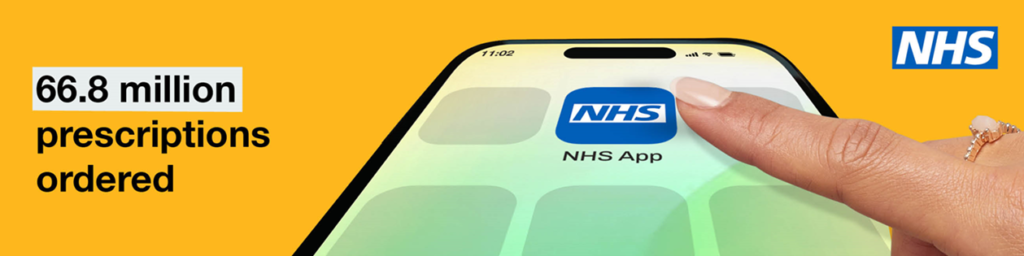
- NHS App or NHS Website
The most convenient method is through the NHS App or the NHS website. Simply log in to your account, navigate to ‘Request repeat prescriptions,’ and select the medications you need. If you haven’t set up an account yet, please visit the NHS website for instructions. - GP Online Services
You can also use our Practice Online service – Patient Access - In Person
Bring the paper form to the surgery or use the red post-box outside - Please note that for reasons of patient safety we do NOT take requests for repeat prescriptions over the telephone
Private Prescriptions
Prescribing responsibility is not simply transferable. This means an NHS doctor – who hasn’t had the benefit of your private consultation/ examination – cannot simply convert a private prescription to an NHS prescription. Equally, a doctor you have paid to see privately can’t issue a prescription on the NHS.
It is Gold Street Surgery’s policy not to convert private prescriptions to NHS prescriptions. A private prescription is not written on an official NHS prescription and will not be paid for by the NHS. The costs of a private prescription must be met wholly by the patient, and is dictated by the cost of the medicine plus the pharmacist’s charge for supplying it.
Similarly, hospital prescriptions should be dispensed by the hospital, NOT brought to the surgery.
There are also some medications which your NHS doctor may recommend (such as travel vaccinations), but for which the NHS does not pay. The patient has to pay for them, even though they may be given by the surgery, to recover the costs of the medicine, administration and staff time.
If we have your correct details, you will receive a text when your medication is ready.
Collecting your prescription
Please allow five working days before collection and make allowances for weekends and public holidays. Where possible, give exact drug names when ordering. You will need to choose a pharmacy to collect your prescription from. We call this nominating a pharmacy.
You will need to choose a pharmacy to collect your prescription from. We call this nominating a pharmacy.
You can change your nominated pharmacy at any time:
- on the app or website where you order repeat prescriptions
- at your GP practice
- at any pharmacy that accepts repeat prescriptions
Dispensary
For our dispensing patients (you must live more than a mile from the nearest registered pharmacy), the dispensary at Gold Street Surgery is open from 8.30am to 5.00pm Monday to Friday, subject to staff availability. Dispensed medication and repeat prescriptions can be collected at any time within Surgery Opening Hours from reception. For further information, please ask a member of our dispensary staff who will be pleased to help. They can be contacted direct on 01799 582623.
More Information
Think Pharmacy First
Think Pharmacy First
Patients can now see a pharmacist first and do not need a GP appointment or a prescription to get advice and treatment for certain conditions.
Questions about your prescription
If you have questions about your medicine, your local pharmacists can answer these. They can also answer questions on medicines you can buy without a prescription.
The NHS website has information on how your medicine works, how and when to take it, possible side effects and answers to your common questions.
Go to Medicines A to Z (nhs.uk)
Batch Prescriptions
The practice are working towards providing patients with batch prescriptions. These will either be 6 months or 12 months at a time. At the end of your prescription cycle, please phone the practice for a medication review with our Clinical Pharmacist before we can re-prescribe further medications.
Electronic Prescription Service
From March 2022 we adopted the Electronic Prescription Service. This means that most repeat prescriptions will be able to be sent to your nominated pharmacy (if you’re a non-dispensing patient) by a secure electronic system. This means a quicker and more streamlined service than the former system, where a paper prescription was printed off and physically given to the pharmacy.
Safety is still assured, as all prescriptions are reviewed by a GP before being sent.
If you order your repeat medication online, this makes the process of ordering and receiving a repeat prescription completely paperless. You will still get a paper order form from the pharmacist when you pick up your medication if you prefer.
Medication reviews in General Practice
If you’ve been asked to have a medication review, it’s often not necessary to speak to a doctor. The surgery has a small team of Clinical Pharmacists – specially trained clinical professionals – able to carry out these reviews on behalf of our GPs. They have full access to your medical history, and are bound by the same rules of confidentiality and discretion as our other clinical staff. Their role is to advise our GPs and Nurses on the latest advances in medicines and to advise patients on how to get the best from them. It is often quicker and more convenient to get an appointment with them than with a GP. This also frees our GPs for the most urgent clinical reviews and treatment.
Why Medication Reviews Matter:
- Safety: They help find and prevent problems with your medications, like bad reactions or interactions.
- Better Treatment: Reviews ensure your medications are still needed and working well. This can lead to changes in dosages or stopping unnecessary medications.
- Patient Involvement: They give you a chance to talk about your medications with your healthcare provider, making sure you understand and agree with your treatment.
- Resource Use: Reviews help reduce medication waste and save NHS resources by optimizing your medication regimen.
- Adherence: Regular reviews help ensure you are taking your medications correctly and address any issues you might have.
For more information, please talk to your GP or a member of our healthcare team.
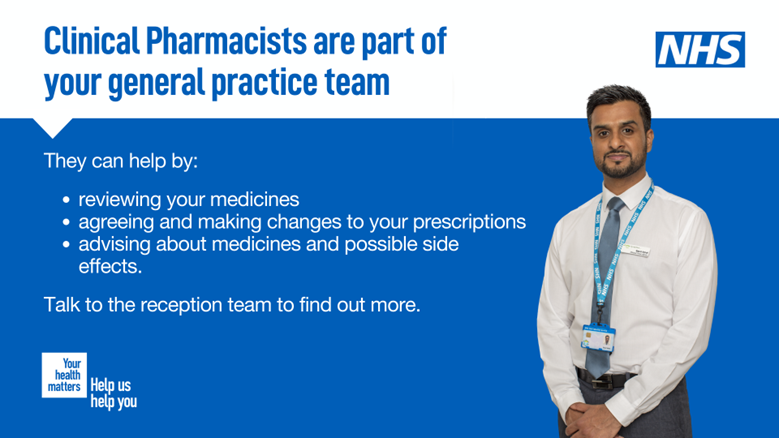
As a practice we have worked with neighbouring surgeries to recruit clinical pharmacists bringing their expertise in medicines to support both patients and our healthcare teams. Here’s how they contribute:
- Medication Management: Clinical pharmacists help manage long-term conditions by reviewing and optimizing medication regimens. They ensure that patients are on the most effective and safe medications for their conditions1.
- Patient Consultations: They consult with patients directly, providing advice on medication use, managing side effects, and addressing any concerns. This helps improve patient understanding and adherence to their treatment plans1.
- Polypharmacy: For patients taking multiple medications, clinical pharmacists review all prescriptions to prevent harmful interactions and reduce unnecessary medications2.
- Health Checks: They conduct health checks and screenings, such as blood pressure monitoring and diabetes management, to help detect and manage health issues early1.
- Support for GPs: By handling routine medication-related queries and tasks, clinical pharmacists free up GPs to focus on more complex cases. This improves the overall efficiency of the practice3.
- Patient Safety: They play a key role in improving patient safety by identifying and resolving medication-related problems, ensuring that treatments are both safe and effective1.
For more information on how clinical pharmacists can support your healthcare, please speak with a member of our practice team.
Prescription charges
Find out more about prescription charges (nhs.uk).
What to do with old medicines
Take it to the pharmacy you got it from or bring it in to the surgery. Do not put it in your household bin or flush it down the toilet.
Buying an NHS Prescription Prepayment Certificate
If you know you’ll have to pay for a lot of NHS prescriptions, it may be cheaper to buy a prescription prepayment certificate (PPC). A PPC covers all your NHS prescriptions, including NHS dental prescriptions, no matter how many items you need. The quickest way to order a PPC is online – Buy or Renew a PPC Online
Where to get the Emergency Contraceptive Pill
If you need the emergency contraceptive pill (morning after pill), you can get free emergency contraception from:
- The surgery, please phone for an urgent appointment
- Most sexual health clinics, also called family planning or contraception clinics
- Some NHS walk-in centres
- Some young people’s services (call the national sexual health helpline on 0300 123 7123 for more information)
- Pharmacies that offer NHS emergency contraception services Find a pharmacy that offers the contraceptive pill without a prescription
Many pharmacies sell the emergency contraceptive pill in their shops and online.
Find emergency contraception services
Getting contraception if you’re under 16
Contraception is free and confidential, including for young people under the age of 16.
The doctor or nurse will not tell anyone, including your parents or carer, unless they think you or someone else is at risk of harm. Remember, the sooner you take the pill after unprotected sex, the more effective it will be. For more information, please speak with your pharmacist, GP, or visit the NHS website.
How your local community pharmacies can help
Pharmacists can offer advice on a range of illnesses, such as coughs, colds, sore throats, ear infections and aches and pains.
Most pharmacies can offer prescription medicine for some conditions, without you needing to see a GP or make an appointment. This is called Pharmacy First.
The conditions covered are:
If you are not within these age ranges, a pharmacist can still offer advice and support decisions about self-care treatment with over-the-counter medicines, but you may need to see a GP for treatment.
If they cannot help you themselves, they can refer you to a GP or other health professional.
Other services that may be available at a local pharmacy include:
- Advice from a pharmacist after contacting NHS 111 or a GP
- Chlamydia screening and treatment
- Advice and help on how to stop smoking
- Cholesterol and blood sugar testing
- The substance misuse service, including needle and syringe exchange schemes
- Advice and help on how to manage your weight
Ask a local pharmacist to find out what services they offer. Think Pharmacy First.
About pharmacists
As qualified healthcare professionals, pharmacists can offer advice on minor illnesses such as:
- coughs
- colds
- sore throats
- tummy trouble
- aches and pains
They can also advise on medicine that you can buy without a prescription.
Many pharmacies are open until late and at weekends. You do not need an appointment.
Most pharmacies have a private consultation room where you can discuss issues with pharmacy staff without being overheard.
Dispensing
We have provision to dispense to patients who live more than one mile in a straight line from the nearest chemist. The health service regulations on this matter are very strict and this service can only be offered to those patients who register as dispensing when they join the practice or when they move house. For further information please ask a member of our dispensary/reception staff.
It is our practice policy to dispense one month’s supply only of medication at each prescription repeat. If you are ordering prescriptions online please be aware that the status ‘accepted’ does not mean the prescription is ready for collection. We still need three complete working days before collection and make allowances for weekends and public holidays.
If you are finding you require more than two items a month on repeat medication a prepayment card is available, which can save you some money. To find out more information, please click on this link. https://apps.nhsbsa.nhs.uk/ppcwebsales/patient.do
Sedative Prescribing for Fear of Flying/Procedures
Crocus Medical Practice does NOT prescribe sedatives for fear of flying or medical procedures under specialist care.
This policy decision has been made by the GP Partners and is adhered to by all prescribers working in the practice. The reasons for this can be found below:
- Diazepam is a sedative, which means it makes you sleepy and more relaxed. If there is an emergency during the flight it may impair your ability to concentrate, follow instructions and react to the situation. This could have serious safety consequences for you and those around you.
- Sedative drugs can make you fall asleep, however when you do sleep it is an unnatural non-REM sleep. This means you won’t move around as much as during natural sleep. This can cause you to be at increased risk of developing a blood clot in the leg or even the lung. Blood clots are very dangerous and can even prove fatal. This risk is even greater if your flight is greater than four hours.
- Whilst most people find benzodiazepines like diazepam sedating, a small number have agitation and aggression. They can also cause disinhibition and lead you to behave in a way that you would not normally. This could impact on your safety as well as that of other passengers.
- According to the prescribing guidelines clinicians follow (BNF) Benzodiazepines are contraindicated (not allowed) in phobia. Your clinician is taking a significant legal risk by prescribing against these guidelines. They are only licensed short term for a crisis in generalised anxiety. If this is the case, you should be getting proper care and support for your mental health and not going on a flight.
- Diazepam and similar drugs are illegal in several countries. They may be confiscated, or you may find yourself in trouble with the police.
- Diazepam stays in your system for quite a while. If your job requires you to submit to random drug testing, you may fail this having taken diazepam.
- For any medical procedures such as an MRI, CT scan on dental procedures, this should be discussed with your specialist. They will make an informed clinical decision on the risks and benefits in prescribing this to you, for the purpose of the procedure.
- We appreciate that fear of flying is very real and very frightening. A much better approach is to tackle this properly with a Fear of Flying course run by the airlines and we have listed a number of these below.
- It is important to tell your travel insurer about your medical conditions and medications you take. If not, there is a risk of your insurer not paying if you try to make a claim.